Related Articles
Ankerdine Hill
27th February 2026
Spotlight on Green Hairstreak
29th April 2026
Penny Hill Landfill Site
Work continues at this former quarry to benefit Dingy Skipper and Green Hairstreak, along with a host of rare plants
January 2026
Following a busy winter of work days, we were rewarded with quite early emergences of butterfly species in spring 2025. The first Dingy Skippers were reported to me on 25 April, followed almost immediately by Wood Whites and Green Hairstreaks.
A fortnight later, we had just under a hundred Dingies and 45 Wood Whites, which I think is quite remarkable for a small site of around 12 acres. Also, the Wood Whites have only been there for about five years, after what was as far as I know a natural colonisation.
I recorded a couple of Small Heaths this year, which seems to be a first for the site.
.jpg) Dingy Skipper (Steve Seal)
Dingy Skipper (Steve Seal).jpg) Green Hairstreak (Steve Seal)
Green Hairstreak (Steve Seal)Orchids, of which we have eight species, had a mixed year with the early ones doing well but the later ones struggling in the heat and drought. Penny Hill has virtually no top soil so, by mid-summer, it was scorched.
I can now report that in 2024 I recorded Yellow Bird's-nest (Hypopitys monotropa), which was the first record for this very rare plant species in Worcestershire for many decades.
This winter, work began by clearing trees and scrub from around power lines near the entrance, moving on to clear a steep bank that hadn't been touched in over a decade. This bank is very flower-rich and gets the full benefit of the morning sunshine into the afternoon. I'm sure the Dingies will enjoy it, as they did last time it was cleared. I've treated the cut stumps to keep it clear this time.
Work continues with lots of brush cutting and scrub clearance across the site.
Many thanks to all of the volunteers, and thanks especially to Mark Smith the site manager for FCC Environment for being so supportive and funding the use of the chipper. We have to chip rather than burn as there is a constant risk from landfill gas.
We need new volunteers and, for anyone who feels like coming to help, we meet for a work party on the third Sunday of every month through the winter. Harry Miller will join us with the chipper on Sunday 15 February.
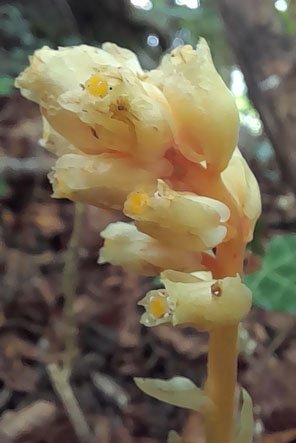 Yellow Bird's-nest
About the site
Penny Hill was quarried for limestone until the late nineties, and was then used as a landfill site. Afterwards, it was capped and the original top soil put back. Some of the buildings remain on site, as does equipment to remove methane from below the surface. There are still exposed areas of Much Wenlock limestone and the site is part of the Geopark Way, which extends from the Forest of Dean in Gloucestershire right up to Shropshire.
It soon became apparent that the site had huge potential. We initially had access for recording and eventually got permission to start doing some work. Seed/hay later collected from the adjacent Penny Hill Bank, a 2.1-acre SSSI owned by Worcestershire Wildlife Trust, and cast across the site. The old quarry took several years to establish but has slowly transformed into an exceptional site, both for its butterflies and for its excellent flora. Notable plant species include Autumn Gentian, Dyers Greenweed, Twayblade, and Spotted, Pyramidal and Bee Orchids.
Penny Hill Bank had small colonies of Dingy Skipper and Green Hairstreak. In 2011, we decided to cut a corridor to link the two sites in the hope that both species would migrate on to the landfill site. This was a huge success and the numbers of both species exploded.
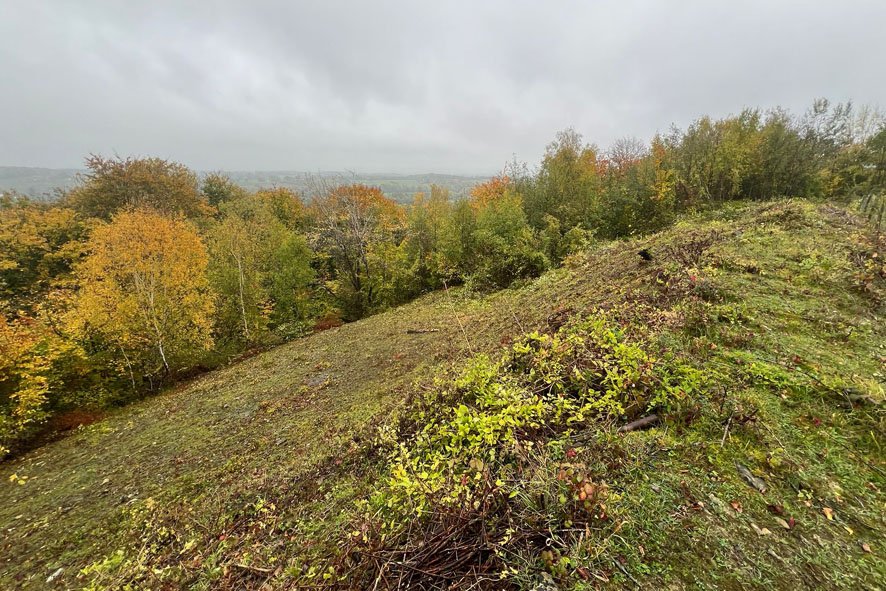 Cleared flower-rich bank