Related Articles
My Volunteering Story - Jenny Joy
31st January 2026
My Volunteering Story - Marian Newell
27th February 2026
My Volunteering Story - Mike Williams
29th March 2026
My Volunteering Story - Trevor Bucknall
29th April 2026
My Volunteering Story - David Shearan
31st May 2026
My Volunteering Story - George Davis
George Davis
Chair, West Midlands Butterfly and Moth Society
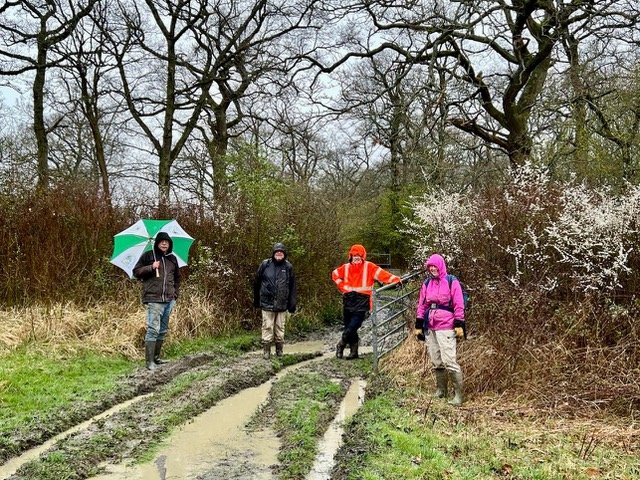
I am privileged to work alongside several highly experienced conservationists and volunteers who have dedicated much of their lives to this work. As for me, now (finally) retired, I work as a volunteer. I come from a business management and finance background, so, as it’s our first Newsletter, perhaps you’ll let me share a bit of my own journey towards volunteering.
When I was a child, I was severely asthmatic and, as a result, I often had to spend many hours at home recuperating, much of it on my own. When I was about eight years old, my mom bought me The Observer Book of Butterflies: I loved it and kept it for years; I was hooked. Many years, and many butterfly (and moth) books later, I went to a talk given by John Tilt, at the Grafton Wood Reserve in Worcestershire, and I knew that I wanted to volunteer.
It was to be another few years before my working life afforded me the time, but eventually I joined John and the conservation team at Grafton with curiosity and a willingness to contribute and to learn. I am now in my fourth year; in fact, as I write, I’ve just got home after five hours of brush-cutting and I ache from head to foot. Great fun! In truth the experience has been rewarding, both in terms of enjoyment, my general physical health and in seeing first-hand the direct benefits to local butterfly and moth populations.
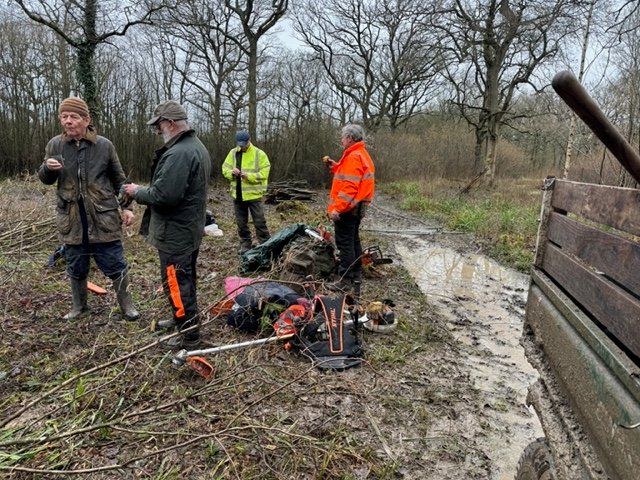
Although I have been known to help at other sites in Worcestershire, I typically work at Grafton most Wednesdays between the middle of August and the end of March. There’s usually around a dozen of us, occasionally a couple more, and our work covers firstly coppicing, typically two coppices per season. This involves me removing the understory (bramble, wild rose, hazel and so on) and means getting stuck in with my brush-cutter, before some of the others take out bigger stuff with chainsaws. We're doing this to clear the ground under oaks to allow various flora to blossom – which they do, with amazing rapidity.
Other, and equally important, tasks are ride-management, mowing, cutting back and generally tidying up. This is beneficial to butterflies, and particularly to one of our two specialist species, the Wood White. Our other speciality, the Brown Hairstreak, benefits from our careful management of blackthorn.
We also do a bit of fencing, particularly around our ponds, and clear the occasional ditch. We leave top-level forestry work to Worcestershire Wildlife Trust, with whom we work closely.
All the former committee members of Butterfly Conservation West Midlands who recently got together to form WM-BAMS did so because we share a belief that local butterfly and moth conservation is best served by being managed by experienced people who live in the area, and where monies raised locally are used locally rather than nationally. That said, we will continue to collaborate with many conservation organisations that operate nationally as well as locally.
Local reserves and sites are crucial sanctuaries for many butterfly and moth species, and your involvement, in whatever way, is invaluable. We all know that modern life can be hectic, particularly for younger people, and this means that volunteering on-site is not always possible for everyone. But, if like me, it might appeal to you ‘in the future’, why not pop it on your retirement bucket list?
Meanwhile, if you have a knack for photography and can contribute to our website and next year's calendar, have the enthusiasm to help run events like moth mornings or butterfly walks, or if you can organise a fundraising event such as a garden open day or craft sale, there are many ways to make a difference – ‘every little helps’, as someone once said.
Going forward, I intend to continue at Grafton and hopefully one or two more sites as well, together with supporting where I can my colleagues at WMBAS. For the record, born in Sutton Coldfield, I’m married, live in North Worcestershire and have two grown-up kids, both living in London. I paint, try to play electric guitar, and am interested in history, art and, of course, butterflies and moths!