Related Articles
My Transect - Grafton Wood
29th April 2026
My Volunteering Story - Trevor Bucknall
29th April 2026
Migrant Moths
29th April 2026
The Clouded Yellow Invasion of 2026
Mike Williams, committee member of West Midlands Butterfly and Moth Society, looks into one of this year's most memorable butterfly phenomena, focusing on his home county of Worcestershire.
Abundance
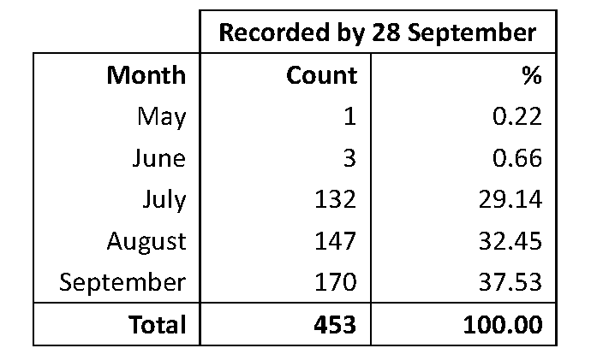
The following table shows the build-up in numbers and demonstrates clear breeding success.
The following maps show records submitted only to iRecord which, despite the above limitations, do give an overall impression of the spread of records and the numbers involved. The first map looks at the West Midlands as a whole (including Herefordshire, Staffordshire, Shropshire and the Birmingham and Black Country conurbation) and compares it to 2025, which was also a reasonably good year for Clouded Yellow. The second map shows records only for Worcestershire, up to 22 September, and provides some feel of abundance at various sites.
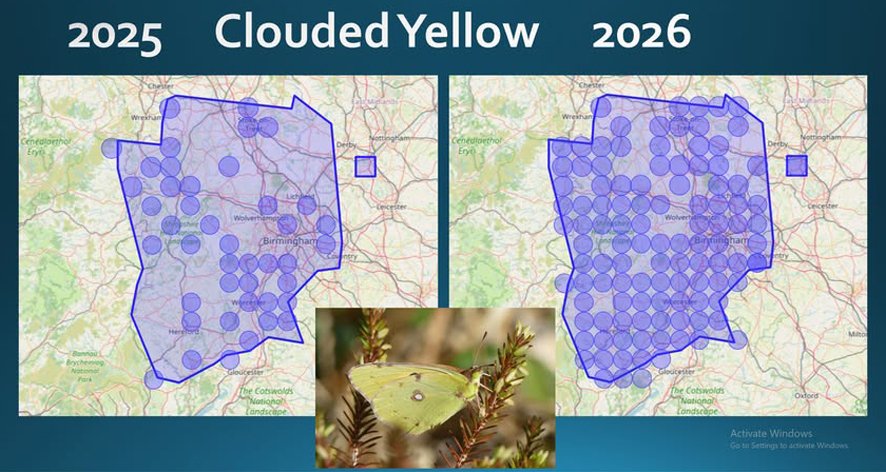 Increase in Clouded Yellow in 2026 compared with 2025
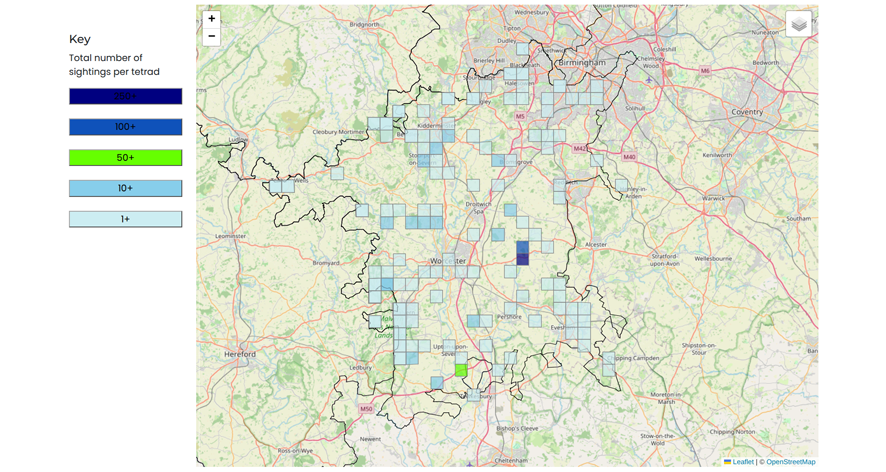 Sightings of Clouded Yellow in Worcestershire
Naming and appearance
The name Clouded Yellow was first given to the species by Benjamin Wilkes in 1742 and is thought to refer to the dark borders found on the upperside of the butterfly, although it may derive from the ‘clouds of butterflies’ seen coming ashore in a good year having crossed the Channel from Continental Europe. Males and females are easily distinguishable, with the male having solid black borders while the female has pale spots within the border. This is usually discernible on landing if not in flight and some photographers also managed to achieve open wing shots. There is a form of the female called helice, where the ground colour is white rather than yellow, and this seemed particularly prevalent this year.
.jpg) Clouded Yellow in Grafton Wood (Craig Jones)
Clouded Yellow in Grafton Wood (Craig Jones) .jpg) Pair of Clouded Yellow in flight, helice form of female (John Devries)
Pair of Clouded Yellow in flight, helice form of female (John Devries)
Life cycle
The butterfly’s true home is North Africa and southern Europe. Those we see in Britain are the result of migration, as the species is continuously brooded, and it is thought that our winters are not suitable for the butterfly to survive. This, as with some of our other migrant species such as Red Admiral, seems to be changing and there is now evidence of individuals getting through our winters in the far south. Whether we will ever see this in Worcestershire remains to be seen but certainly something to look out for.
It's not too difficult to spot eggs and larvae, especially if one can follow an egg-laying female, and it would be an interesting project to try to follow any eggs found through the winter. They are skittle-shaped, like Orange Tip eggs, and are laid on the upper-side of the leaves of the food plant, mainly clovers and bird’s-foot trefoil. Pale yellow at first, they turn bright orange after a few days. They hatch after one or two weeks and development as a larva is fairly rapid, perhaps as short as three weeks with another three weeks as a pupa, if temperatures are high as they were this summer.
.jpg) Clouded Yellow egg (Steven Croft)
Clouded Yellow egg (Steven Croft)
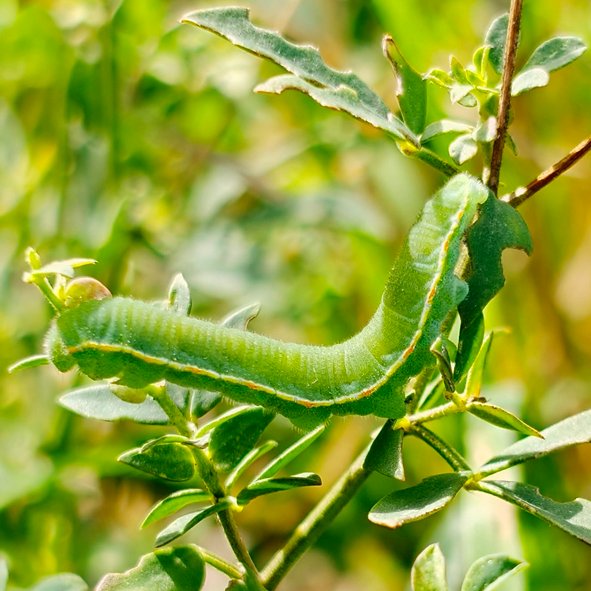 Clouded Yellow larva, final instar (Jane Cole)
Outside these hotspots, most sightings in July were of one or two individuals that quickly moved on. The main invasion period during the first two weeks of July coincided with favourable weather that no doubt encouraged movement and breeding. Numbers continued to build during the rest of July and August; local breeding success meant that Clouded Yellows were still being reported in numbers well into September. As late as 20 September, a conservation task run by West Midlands Butterfly and Moth Society near Martley was enlivened by Clouded Yellows well into double figures, including several helice females. There was also evidence of dispersal away from favoured grassland sites into other habitats, including woodland and even gardens. Wherever late flowering nectar sources were to be found, there seemed to be a good chance of Clouded Yellows.
At the time of writing (late September), Clouded Yellows are still in evidence and likely to persist well into October if good weather holds. There is a return migration but its scale is uncertain, although there are several eye-witness accounts of waves of Clouded Yellow heading out to sea and being seen from ships in the English Channel. Many presumably perish as a result of frost or gales, so enjoy them while you can.
Acknowledgements
- David King, Mel Mason and David Shearan for their help with Clouded Yellow records and maps.
- All those who submitted records via iRecord, without whom this article would not have been possible.